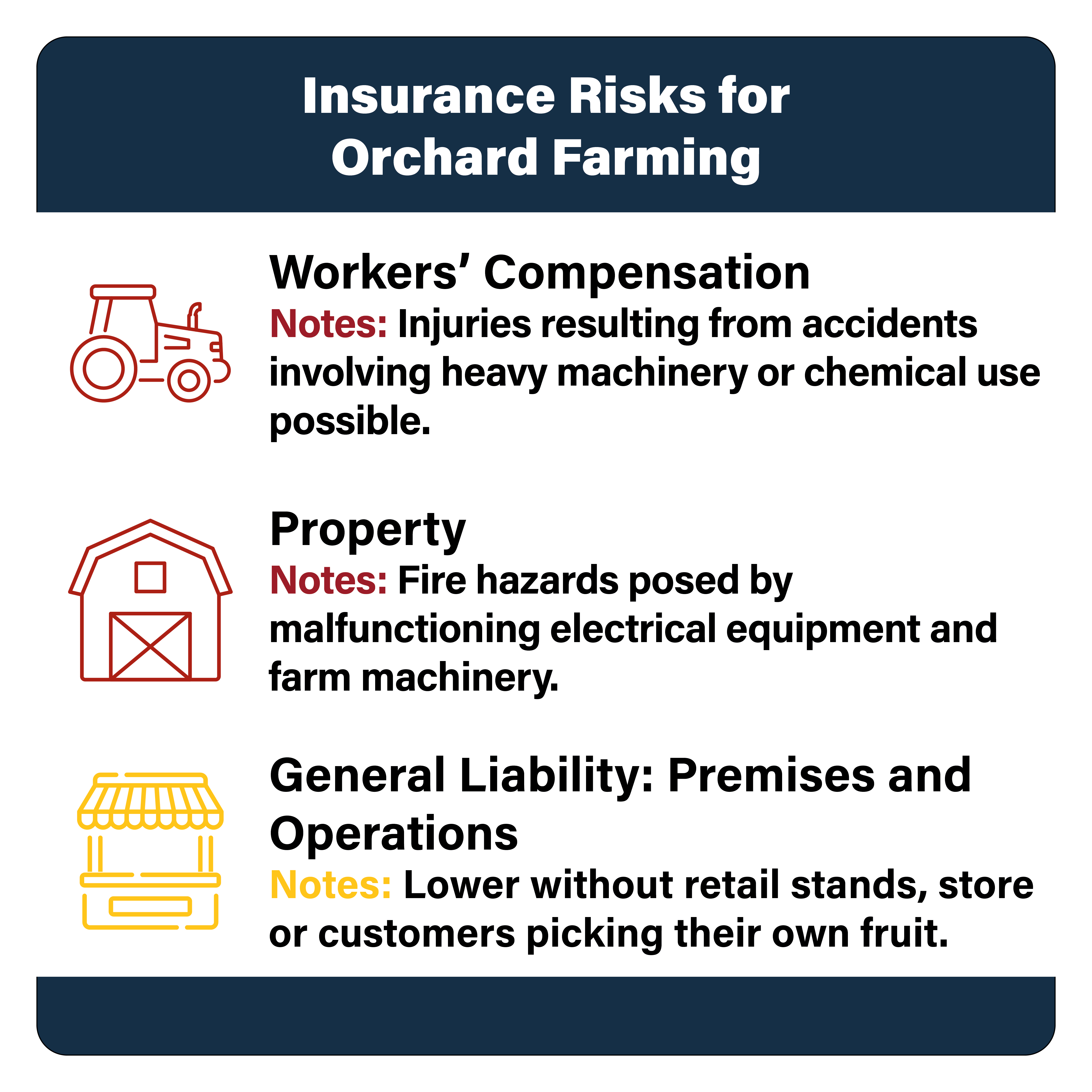
Orchards are farms that primarily produce fruits or nuts on trees. Some large farms maintain their own packing and shipping facilities. Smaller farms often operate roadside stands, or they may transport fruit to a local packing company that handles the harvests of several farms. Producers could also ship fruits or nuts to terminal markets or sell directly to wholesalers, distributors, supermarkets or canning/processing companies.
Learn More
The Best's Underwriting Report offers a detailed summary of each line of insurance, answering questions such as:
- What hazardous substances do employees work with, and how can the insured verify their safe handling?
- What are positive underwriting signs that an orchard is prepared for a fire emergency?
The Best’s Loss Control Report gives you the big picture for exposures and controls, with questions to consider such as:
- Are farmers trained to use specific ladders for orchard-related tasks and not for general-use purposes?
- What type of rodent control program does the insured have in place to prevent pests from gnawing on electrical wiring in barns and other out-building areas?
Orchard farms, based on the Global Industry Classification Standard* for Agricultural Products & Services, has an MSCI ESG Risk Intensity Score** of 9 as of September 24, 2024.
Read our Best’s Review article to learn more about the risks that orchard farmers face. You’ll also find excerpts from our reports, including information on lines of coverage and questions for on-site inspections.
*The Global Industry Classification Standard (GICS) is the global industry classification standard jointly developed by MSCI and S&P Global Market Intelligence and a widely accepted approach to defining industries and classifying securities by industry.
**The ESG Risk Intensity Score is a quantitative assessment of industry ESG risk, where a score of 10 corresponds to the highest level of risk relative to all other industries. Each GICS sub-industry’s ESG Risk Intensity Score is based on the average risk score across the environmental, social and governance pillars, which is then converted into a decile-based score, where a score of 10 is assigned to the top 10% highest-risk sub-industries. For more information on MSCI ESG products and services, please contact ClientService@msci.com.
Copyright © 2026 A.M. Best Company, Inc. and/or its affiliates. All rights reserved.
No portion of the content may be reproduced, distributed, or stored in a database or retrieval system, or transmitted, or uploaded into any external applications, bots or websites, including those using artificial intelligence technologies such as large language models and generative AI in any form or by any means without the prior written permission of AM Best. AM Best does not warrant the accuracy, completeness or timeliness of the AM Best content. While the content was obtained from sources believed to be reliable, its accuracy is not guaranteed. You specifically acknowledge that neither AM Best nor the content gives any investment, financial, tax, insurance or legal advice. You are solely responsible for seeking competent professional advice before making any investment, financial, tax or insurance decision. For additional details, refer to our Terms of Use.